OWNED
AUDIENCE
PLAYBOOK
Social media gets most of the attention in email growth conversations.
Fair enough. It's visible, it's easy to measure, and it feels like it scales. But there's a whole category of growth that gets underestimated, because it happens quietly, one conversation at a time, with no vanity metrics attached.
Direct channels. The DMs, the messaging apps, the reply threads, and the emails you're already sending to people who aren't on your list yet.
It's not the flashiest chapter in this guide. For a lot of people, though, it'll be the one you can act on today, because it works with contacts and conversations you already have.
WhatsApp: underrated, especially in certain markets
More than three billion people use WhatsApp. In South Africa, across much of Africa, and in big parts of Europe, Latin America and Asia, WhatsApp is simply how people talk, at home and at work.
So if you're building a newsletter in any of those markets and WhatsApp isn't part of your thinking, you're missing something real.
One thing to be clear on upfront: we're talking about using WhatsApp to point warm contacts towards your newsletter. The moment it starts feeling like a blast channel, it stops working (and damages relationships you actually care about).
Your WhatsApp Business profile. If you use WhatsApp for work at all, the free WhatsApp Business app is worth switching to. Your profile gets a description and a website link, so point that link at your sign-up page. Anyone who checks your profile sees it, with zero ongoing effort from you.
Greeting and away messages. These fire automatically when someone messages you for the first time, or outside your working hours. Most people leave them as a generic "thanks for getting in touch". Add one natural line about your newsletter instead:
"Thanks for reaching out! I'll get back to you within a day or so. In the meantime, if you're into email marketing, I write a fortnightly newsletter on exactly this. Happy to share the link when we chat."
Channels. A WhatsApp Channel is a one-way broadcast that people choose to follow, which makes it a neat (and consent-friendly) way to share each new issue with the people who want it.
Broadcast lists, used carefully. Broadcasts send one message to many contacts, and each person receives it as a private message. Keep them for warm contacts who'd actually want what you're sharing, and keep them rare. One useful message a month is welcome. A weekly link-dump is the fastest way to get blocked by people you know. (WhatsApp has also been testing monthly caps on broadcasts and paid broadcast options for businesses since 2025, so check your app's current limits.)
Groups and Communities, with clear boundaries. A WhatsApp group around your newsletter topic can feed your list naturally, because members who come for the conversation often end up subscribing too. Make joining opt-in, keep the group focused, and position the newsletter as an extension of the group rather than the reason it exists.
Nobody joins a WhatsApp group to be marketed at. They join for the conversation. Earn that first.
Email-to-email: the channel hiding in plain sight
Here's one that barely gets a mention in most growth guides, despite being one of the most reliable tactics around.
You're already emailing people.
Clients, prospects, colleagues, collaborators, suppliers, people who filled in your contact form, people you met last month. Most of them aren't on your newsletter list. And many of them would join if you asked in the right way.
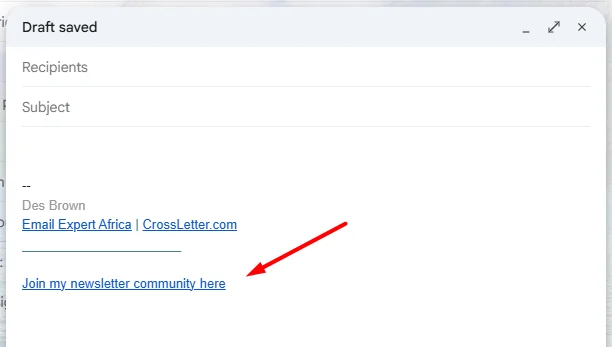
Your email signature. Every email you send carries it. A single line below your contact details does the job: "I write a fortnightly newsletter on [topic]. Join here: [link]." Quiet, unobtrusive, and working away in the background of every email you send.
The personal ask. For people you have a real relationship with, a direct, personal email inviting them to subscribe is completely appropriate (and often surprisingly effective). Mention something specific about them or what they care about, explain in a line or two what the newsletter covers and why they might like it, and make the action easy.
This is one email to one person that happens to mention your newsletter. Across your network, that adds up.
From the Email Advice in Your Inbox archiveVol. 68, How to Write Emails to One ReaderRead it →The web version share. Most email platforms give each issue a web version that anyone can read. When an issue answers a question someone asked you, send them the link. Let them experience the content before you ask them to commit to it.
The reply-to strategy: turning replies into relationships
Most newsletter senders treat replies as a nice bonus. Someone hits reply, says something kind, and you feel good for a moment before moving on.
That's a missed opportunity.
Someone who replies read carefully enough to have a reaction worth sharing, which makes them one of the most valuable people on your list. They're also among the most likely to refer others, if you give them a reason. (Bonus: replies are one of the clearest positive signals an inbox provider can see.)
So what do you do with them?
Reply personally. Skip the template and the "thanks for the kind words". Respond to what they actually said and add something to the conversation. That's how a subscriber starts to feel like they know you, and people who feel that way stick around.
Ask a follow-up question. What are they working on? What have they tried? What would help most? These conversations hand you your next content ideas, and they deepen the relationship while they're at it.
Spot the referral moment. When someone replies enthusiastically about an issue, that's the right moment to say (briefly, naturally) that you'd love them to share it with anyone who'd find it useful. Keep it informal. You're two people already mid-conversation.
Direct outreach, done like a human
There's a version of direct outreach that's spam. You've probably received it: a cold message from a stranger, pushing a newsletter you have no reason to care about.
This is the other version.
Reach out to specific people who've given you a real signal that your newsletter might be useful to them. Someone who commented thoughtfully on your post. Someone who asked a question in a community that your newsletter answers directly. Someone an existing subscriber suggested you speak to.
Keep the message short, specific and about them. Say what made you think of them, explain in a line what your newsletter covers, offer the link, and leave the decision with them.
One message. No follow-up if they don't respond. No hard sell.
Done at a small scale, with care, this brings in subscribers who are warm before they open their first issue. And warm subscribers engage at rates cold sign-ups rarely match.
Why these quiet channels matter
None of this scales like a viral post or a referral programme. Let's be honest about that.
What it does is build a steady floor of high-quality growth. Subscribers who arrive through a personal conversation, an email signature, a WhatsApp share or a reply thread tend to be more engaged and more loyal, and more likely to refer others, than people from almost any other source.
They're harder to track on a dashboard. They don't make a pretty growth graph for a presentation. But over time, they become the part of your audience that feels most connected to what you're building.
From the Email Advice in Your Inbox archiveVol. 77, Relationship or Transaction?Read it →So, a challenge for this week: who are five people you've emailed this month who'd find your newsletter useful? What's stopping you from asking them?
Want this chapter for later? Grab it as a PDF, free.