OWNED
AUDIENCE
PLAYBOOK
Hey LinkedIn folks, quick one: if LinkedIn vanished tomorrow, how many of your followers could you email?
For most people, the honest answer is somewhere between "very few" and "none". Which is a little scary when you've spent years building that following.
Let's be fair to LinkedIn, though. It has a reputation problem (humble brags dressed up as life lessons, "10 things my dog taught me about B2B sales" carousels, you know the ones). But for anyone building a newsletter, a consulting practice or a personal brand in a professional niche, few channels put you in front of the right people as directly.
Your followers there are one step away from becoming subscribers. Most people just never give them a reason to take it.
Start with your profile (it works while you sleep)
Your profile gets viewed every time you post, comment or turn up in search. Every one of those views is a potential subscriber. If your profile doesn't point anywhere, those views just evaporate.
A quick housekeeping note first: if older advice tells you to "switch on Creator Mode", you can skip that step. LinkedIn retired it in 2024 and folded most of its tools into every profile.
What's worth getting right:
Your headline says who you help. Your job title and company name aren't a reason to follow anyone. "Helping newsletter operators grow audiences they actually own" tells a visitor straight away whether you're worth their time.
Your Featured section points to your list. It's prime real estate, and most people waste it on a post that did well in 2022. Pin your sign-up page there, plus your best recent issue.
Your About section is a soft pitch. Lead with what you do for your reader (not your career history), write it like a human, and end with a clear pointer to your newsletter.
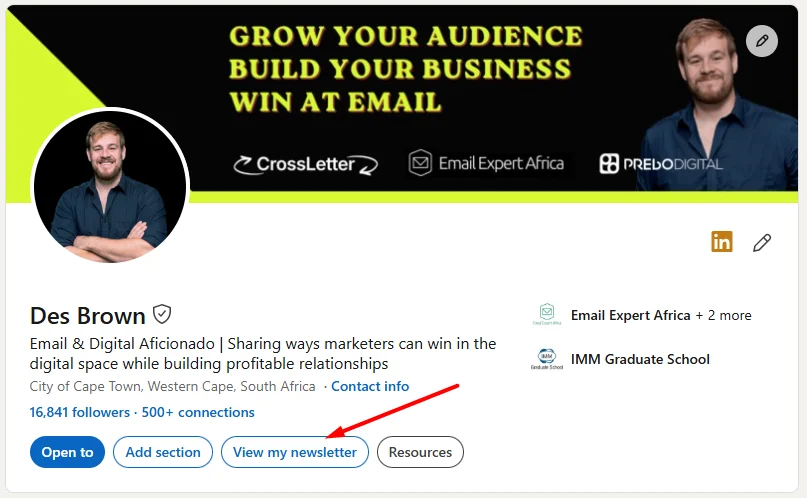
Your custom button, if you have one. LinkedIn Premium lets you add a button right under your headline (ours says "View my newsletter"). It's the first thing a visitor can tap, so point it at your sign-up page. No Premium? Your Featured link does the same job, just a scroll further down.
Content that earns the click
Growing on LinkedIn comes down to showing up, consistently, with content that earns attention.
Easy to say. But most LinkedIn content is too sporadic, too polished or too salesy to earn trust (sometimes all three at once, bless).
What works for newsletter growth is content that shows your expertise without asking the reader to trust you first. Practical. Specific. The kind of post that makes someone think, "huh, I've been doing this wrong."
A few formats that tend to perform:
Short frameworks. A numbered breakdown of how to tackle one specific problem. Three to five points, each with enough substance to be useful. These get saved and shared more than most formats.
Contrarian takes. A challenge to something widely believed in your niche, backed by your own experience. Not provocation for the sake of it. These get people commenting, and comments expand your reach.
Behind-the-scenes observations. Something you only know because you do the work. This builds trust faster than almost anything else.
Newsletter snippets. A condensed version of something from a recent issue, with a pointer to the full piece. LinkedIn gets the teaser. The inbox gets the whole thing.
From the Email Advice From A Friend archiveSabahudin Murtic, The Truth About LinkedIn Lead MagnetsRead it →LinkedIn newsletters: useful, but not yours
LinkedIn has its own newsletter feature. When someone subscribes, they get a notification inside LinkedIn and an email from LinkedIn each time you publish.
That sounds like a mailing list. Here's the catch.
You can't export those subscribers, and you can't email them yourself. You can see who subscribed. You can't take them with you. Your LinkedIn newsletter audience is LinkedIn's audience, pointed in your direction for as long as LinkedIn chooses to keep pointing it.
Does that make it useless? Not at all. It's a brilliant warm-up act. Your name lands in people's inboxes, they get used to reading you, and that makes the next step (joining a list you actually own) feel natural.
The play is simple. Publish something worth reading on LinkedIn, and end every edition with a clear invitation to your own newsletter, where the deeper stuff lives. You don't need to write two completely different things. Your LinkedIn edition can zoom in on one angle of your latest issue. LinkedIn teases. Your newsletter delivers.
The DM approach most people never try
This is the part of LinkedIn growth almost nobody talks about. Probably because it feels a bit awkward. But done with care, it works.
Direct messages.
Cold DMs are off the table. ("Hi! I see you're in marketing, have you considered my course?" has earned its terrible reputation.) What we mean is far more human.
When someone engages properly with your content (a thoughtful comment, a specific question, a reaction that clearly landed), they've put their hand up. A short, personal DM at that moment simply carries on a conversation they started.
The formula:
- Acknowledge the specific thing they said.
- Add one line of extra value on that topic.
- Mention that your newsletter goes deeper on exactly this.
- Leave the door open, and leave it there.
Something like:
"Thanks for your comment on the deliverability post. You made a good point about sender reputation, and we went a lot deeper on that in last week's newsletter. Happy to send you the link if it's useful, no pressure at all."
That's it. No pitch, no funnel, no sequence. One person offering something relevant to another person who's already shown interest.
A few boundaries:
- Only message people who've actually engaged with your content.
- Keep it short, with one clear ask that's easy to decline.
- No reply? Leave it. One message starts a conversation. Two unanswered ones start a problem.
Do this consistently and you'll build a steady stream of warm conversations. Some become subscribers on the spot, some become client conversations, and a few become proper professional friendships.
Show up on a rhythm you can keep
The most common LinkedIn mistake? Posting in bursts.
Three posts in a motivated week, then three weeks of silence, then another burst. Your audience never learns when to expect you, so they never really start looking out for you.
You don't need to post every day. Three times a week is a solid, sustainable rhythm for most people. What matters more than frequency is regularity.
Pick a cadence you can keep up for six months. That's the real constraint, and it has a lot more to do with your calendar than with the algorithm.
Connect with intention
Who you connect with shapes who sees your content.
If your newsletter is for marketers, a network full of people who don't care about marketing will scroll straight past your posts (and LinkedIn notices). Be choosy: connect with people in your target audience and people who deal with the problems your newsletter solves.
And add a short note to every request: a human reason for connecting, no pitch. It takes 30 seconds and makes a real difference to who accepts.
From follower to subscriber
LinkedIn is where people get to know you. Email is where they get to rely on you.
The move from one to the other is usually a string of small moments: a post that resonates, a DM that goes somewhere, a snippet that makes someone want the full piece. Eventually, they decide they want your thinking on a reliable schedule.
That's when they subscribe.
Your job on LinkedIn is to be worth following, and then to make the next step obvious and easy.
From the Email Advice in Your Inbox archiveVol. 38, Grow Your Email List with LinkedInRead it →So here's a quick audit: look at your last ten posts. How many of them gave someone a reason (and a way) to join your list?
Want this chapter for later? Grab it as a PDF, free.