OWNED
AUDIENCE
PLAYBOOK
Quick question: if you wanted new subscribers for a newsletter about email marketing, where would you look?
You could run ads. Post on social. Optimise your website. All valid (and all covered elsewhere in this guide).
Or you could find the newsletters your ideal subscriber already reads, and get in front of them there.
That's newsletter cross-promotion in a nutshell, and it's one of the most underused, highest-quality ways to grow a list right now.
Why does it work so well? Context. Someone reading a newsletter has already shown they're the kind of person who reads newsletters. They've opted into someone's list, they're engaging with email content, and they're in a receptive frame of mind when they come across a recommendation for something similar.
Newsletter readers are newsletter subscribers waiting to happen.
What cross-promotion actually means
The term gets used loosely, so let's be specific. Cross-promotion is when newsletter senders agree to put each other in front of their audiences. Both sides get exposure to a warm, newsletter-native audience neither would have reached alone.
It usually takes one of three forms:
Swaps. Two newsletters of roughly similar size feature each other in an upcoming issue, usually a paragraph or two each, run in the same week or close to it. This is the most common format.
Recommendations. A lighter-touch version that many platforms build in. Instead of a written feature, your recommendations appear to new subscribers (often straight after they sign up), and they can join with a click. Beehiiv, Kit and Substack all have their own versions.
Sponsored placements. One newsletter pays another to feature it. That's covered in the paid growth chapter, but it's worth knowing where the line sits, because being clear about which is which matters to your readers.
And swaps themselves come in more flavours than most people order: spotlight recommendations, lead magnet swaps, guest sections, group bundles, even trades across podcasts, communities and video.
From The Collaborator archiveIssue #14, The Cross-Promotion Menu You're (Probably) Not Ordering FromRead it →So why isn't everyone doing it?
A few reasons.
Finding the right partner is harder than it sounds. You need a newsletter that shares your audience's interests without competing with your content, that has similar engagement to yours, and whose writer is open to the conversation. Hardly impossible. But not obvious, either.
The outreach feels awkward. Emailing a stranger to propose a swap is uncomfortable, especially when your list is small and you're not sure what you bring to the table.
There's been nowhere obvious to look. Working out which newsletters exist in your niche, how big and engaged they are, and whether they're open to cross-promotion has mostly meant a heap of manual digging, with no guarantee of a result.
That last one is the problem CrossLetter was built to fix.
CrossLetter: built for exactly this
Full disclosure first: we co-founded CrossLetter. We built it because we kept running into the problems above ourselves.
CrossLetter is a free platform for newsletter discovery, cross-promotion and sponsorship. Newsletter senders list their publication with details on their niche, audience size and engagement (opens and clicks), and say whether they're open to cross-promotion, sponsorship or both. Sponsorship placements can be listed with their own pricing, too.
So when you're looking for a partner, you're no longer cold-emailing strangers on a hunch about whether your audiences overlap. You're browsing newsletters whose senders have already put their hand up for the conversation.
The discovery problem is solved before you send a single message.
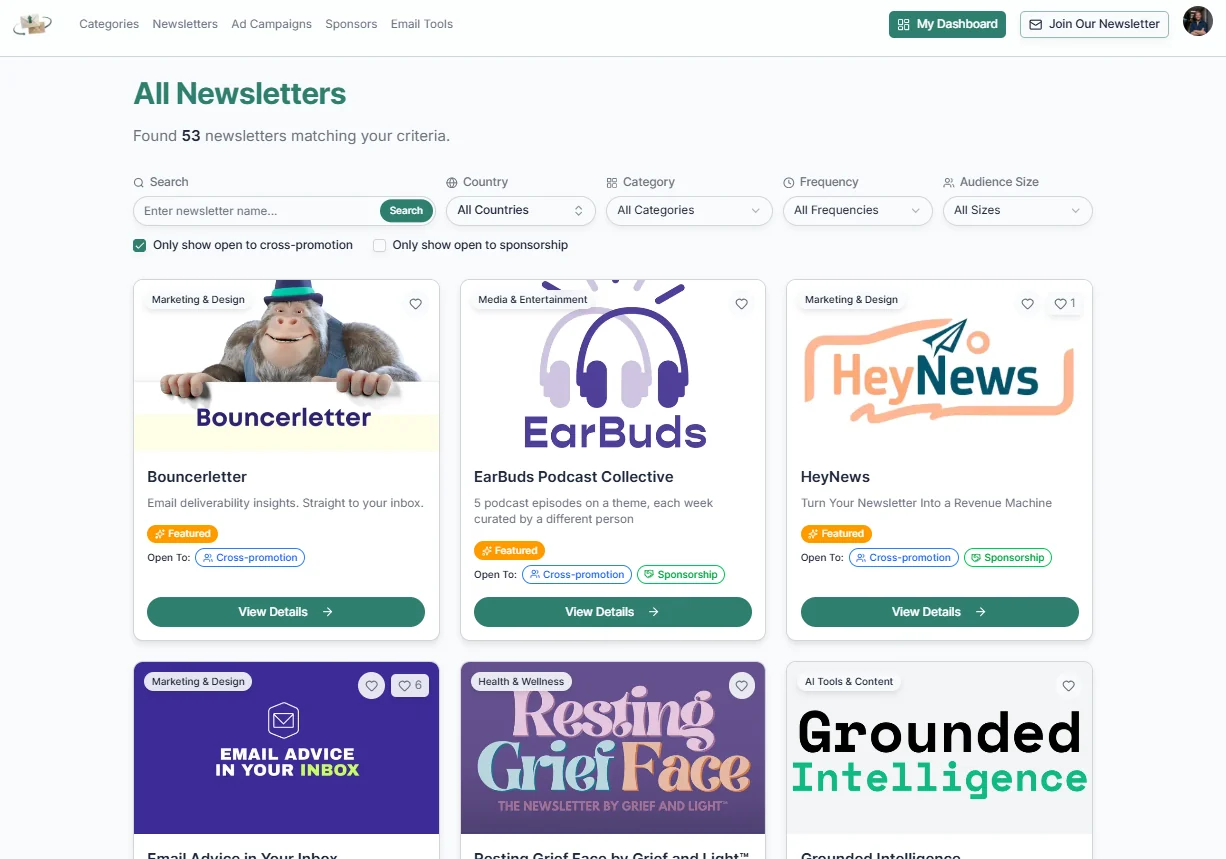
How it fits with the other tools out there. Platform recommendation features (beehiiv's Recommendations, Kit's Creator Network, Substack's recommendations) are brilliant for always-on, click-to-subscribe recommendations, as long as you can find the right newsletters to recommend. Paid networks like SparkLoop's Partner Program let you pay for confirmed subscribers, which can work well (more on that in the paid growth chapter). CrossLetter sits underneath all of it: it's where you find the right partners in the first place, for swaps, recommendations and sponsorships alike. (Want another option for finding partners? We reviewed Bryan's Rolodex in Email Tools TLDR.)
And there's a quality difference worth knowing about. Someone who found you through a recommendation from a newsletter they trust tends to stay longer and engage more than someone who signed up for an incentive.
Finding the right partner
Not every newsletter is a good partner, even if the topic looks close to yours. What to look for before reaching out:
Audience overlap without direct competition. If you write about email marketing, a newsletter on content strategy, copywriting or solopreneurship is often a better fit than another email marketing newsletter. Your readers share interests without one of you cannibalising the other.
Similar engagement quality. A newsletter with 2,000 subscribers and strong click rates will usually do more for you than one with 10,000 subscribers who barely open. Engaged readers are the ones who act on recommendations.
A newsletter you'd actually recommend. Sounds obvious. Gets skipped constantly. If you wouldn't recommend it without the swap, don't recommend it with one. Your readers' trust is what you're spending, so spend it carefully.
A sender who communicates clearly. A swap needs a little coordination (timing, copy, placement). Someone who's slow, vague or disorganised creates friction that undermines the whole thing. A quick back-and-forth before you agree tells you a lot.
From The Collaborator archiveIssue #12, The Vetting Checklist for Pitches That Land in Your InboxRead it →How to pitch a swap
Found a strong fit? Here's how to open the conversation.
Keep it short. The person on the other end is a newsletter sender with limited time and, quite possibly, a few similar requests in their inbox. A concise, specific pitch gets read. Your life story doesn't.
Lead with why it makes sense. Skip the abstract "I think our audiences overlap". Be concrete: "You cover content strategy and we cover email. Readers building content systems would find the email side useful, and vice versa."
Be upfront about your numbers. Share your subscriber count, your engagement and how often you send. If you're much smaller than them, say so, and offer something that balances it out (a feature in two issues, say).
Make the mechanics clear. Which week? What format? Where in the issue? The clearer the ask, the easier the yes.
Put it in writing. Once you've both said yes, confirm the dates, format and placement in a short email. Five lines is plenty, and it saves a heap of awkward follow-ups (we shared a template in The Collaborator #13).
Writing a feature that converts
Getting the swap agreed is half the job. The other half is a recommendation your readers actually act on.
Be specific. "You should check out this newsletter" barely counts as a recommendation. Say what it covers, what format it takes, what readers get from it, and why you personally rate it.
Use your voice. Even if your partner sends suggested copy, rewrite it so it sounds like you. Readers can tell when they're reading a press release.
One clear link. Clearly labelled and easy to tap. Don't make anyone hunt.
Help readers self-select. Something like "if you're building a newsletter and want to get serious about content strategy, this one's worth your time" tells the right reader to click, and the wrong reader it's fine to skip. That gives your partner better subscribers and keeps your credibility intact.
Build a rhythm, not a one-off
One swap is useful. A steady cross-promotion habit is where things really start to move.
The senders who grow fastest through cross-promotion treat it as an ongoing part of their strategy: a swap or two a month, consistently, with partners they've vetted. Over a year, that adds up to a lot of high-quality subscribers, all arriving through warm recommendations.
Getting there means building a small roster of reliable partners. Some become regular collaborators. Others are one-off swaps that don't quite land. Over time, you get a feel for which partnerships are worth repeating.
Two habits make that roster easy to manage. Score every swap (fit, sign-ups, how many of them stick around, how easy the partner was to work with), so you know who's worth repeating. And don't overdo it: one or two recommendations per issue, and not in every issue, keeps them feeling like tips from a friend rather than a noticeboard.
From The Collaborator archiveIssue #10, Score Every Swap So You Know Who's Worth RepeatingRead it → From The Collaborator archiveIssue #16, How Many Swaps Is Too Many?Read it →And as your list grows, your options grow with it. Bigger newsletters come within reach, and as your niche gets clearer, you can be choosier about fit.
A word on transparency
When you recommend another newsletter, only recommend ones you'd happily put your name to. Your recommendation is worth something because your readers trust it. The moment they suspect you're recommending things for other reasons, that trust starts to leak.
And if it's a paid placement, label it clearly. Advertising rules in most markets expect paid endorsements to be disclosed, and beyond the legal side, your readers deserve to know. Good placements don't suffer from a clear label. If anything, it makes the next recommendation land harder.
So, who's one newsletter your readers would thank you for introducing them to? That's your first swap.
Want this chapter for later? Grab it as a PDF, free.